How to Choose Outdoor Furniture That Actually Lasts
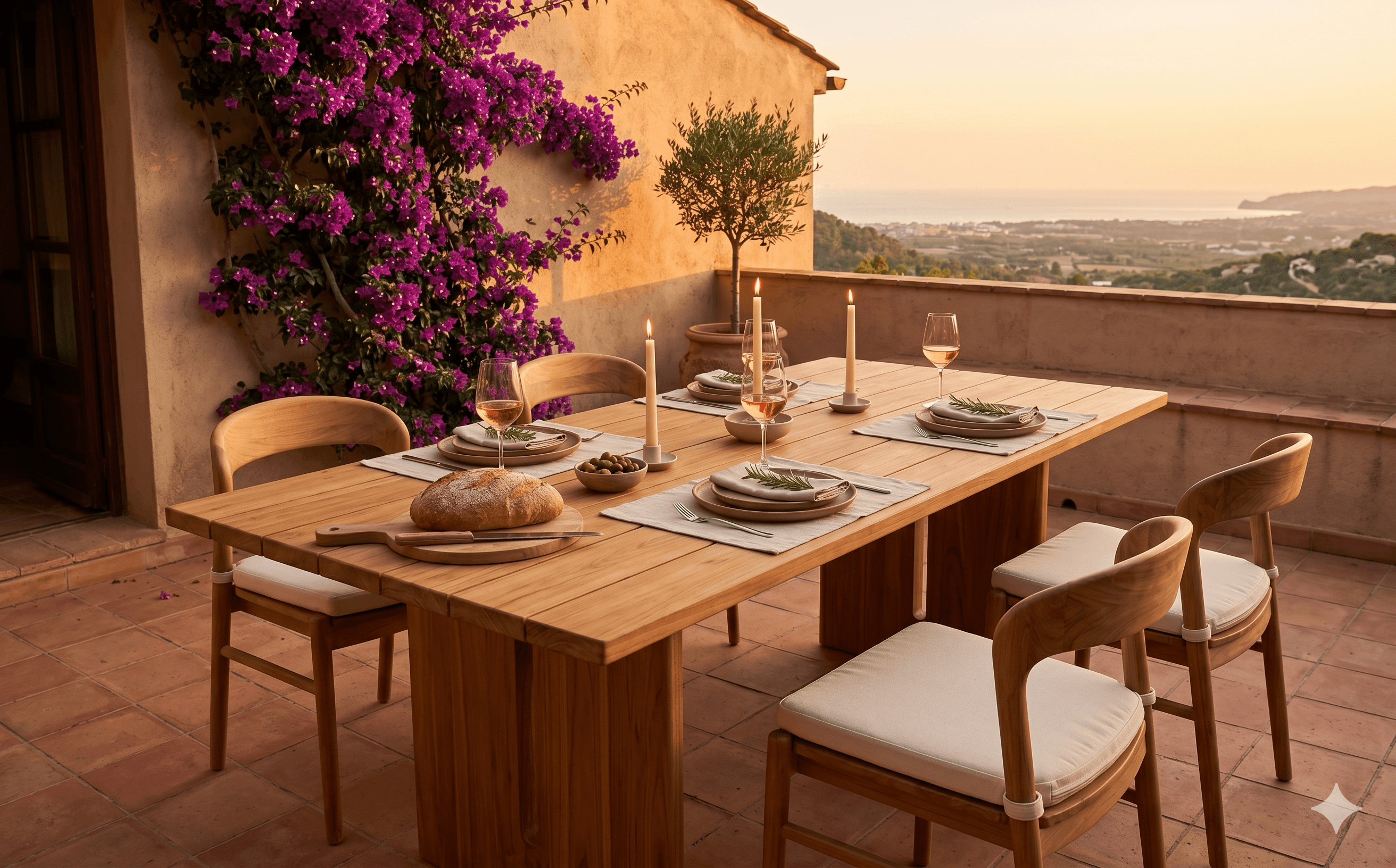
Outdoor furniture has one job that indoor furniture doesn’t: survive.
Rain, sun, salt air, pollen, dust, temperature shifts, the occasional party, the occasional neglect. Most furniture in this category fails its first real summer. Some fail in elegant ways — a fade, a patina. Others fail in ways that are hard to forgive: a cracked frame, a cushion that never dries, a screw that rusts through the seat.
Here is what we’ve learned, sourcing across three continents for six years, about what makes outdoor furniture last.
The difference between furniture that lasts a season and furniture that lasts a decade is almost never the design. It’s the decisions no one tells you about.
1. The wood matters more than the finish.
If you’re looking at a hardwood piece, it should be teak, acacia, or eucalyptus. Not “tropical hardwood” (a meaningless marketing term). Not pine stained to look like teak. Grade-A teak, in particular, has such a high natural oil content that it can be left untreated outdoors for decades and develop a beautiful silver-grey patina without structural damage.
2. The frame is everything.
Ask what it’s made of. Powder-coated aluminum is lightweight, weather-resistant, and fully recyclable. Stainless steel is heavier, stronger, and holds up in salty coastal air. Cheap cast aluminum or painted steel will rust at every weld point within two years. You can usually tell by lifting one end — if it feels light and hollow, walk away.
3. Performance fabric is a real category.
UV-resistant, water-repellent, solution-dyed acrylic or GRS-certified recycled polyester (rPET). These fabrics feel like premium linen or bouclé but perform like technical textiles. Generic “outdoor fabric” is often untreated polyester, which fades in one summer.
4. Quick-dry foam cores are non-negotiable.
The cushion is what makes a seat comfortable, but it’s also what fails first. Look for open-cell foam that drains and dries within hours. Closed-cell foam holds water for days.
5. Hardware should be stainless steel.
Every screw, every bracket, every internal joint. If the manufacturer cuts costs on the hardware you can’t see, it’s the first thing that will fail.
6. Assembly quality is a signal.
Run your hand along a joint. It should feel continuous, hand-finished, tight. Gaps you can see with your eye will become gaps you can feel with your body within a year.
7. And finally: ask for the warranty.
Serious manufacturers back their products with 5 years structural minimum. Anything less means they don’t believe in it either.
The good news: you rarely need to buy twice. A considered, well-made outdoor set should outlive several apartments, several redecorations, and several versions of yourself.
That’s the standard we build to.